Move Well First, Then Move Strong My journey back to my Gait- through the Gateway of Fascia
Feb 23, 2026
by Dolores Everett
Move Well First, Then Move Strong
My Journey Back to My Gait — Through the Gateway of Fascia
I am Dolores Everett.
I am 60 years old.
I am a personal trainer, fitness instructor, and an MMIA and MELT practitioner working with fascia and movement — through and within fascia.
But before any of that…
I was just a girl who loved to move.
My journey began in my teens when my sister and I entered an aerobic competition at our local Lucille Roberts gym. That moment shaped my identity. Movement wasn’t something I did — it was who I was.
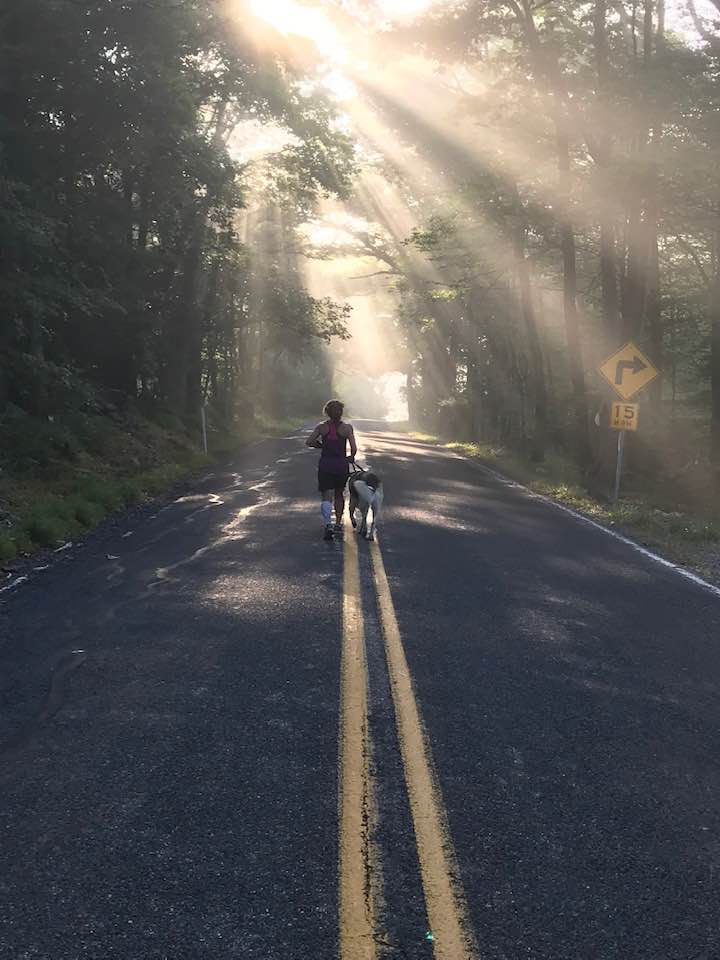
After my second child, I discovered running. It was something I could do alone in the early quiet hours before my children woke and before my husband Todd left for work.
I didn’t like running at first.
I didn’t like the sound of my feet hitting the pavement.
But I grew to love:
The silence.
The rhythm.
The clarity afterward.
I loved the rhythm — though I didn’t yet understand that rhythm began with breath.
Running became therapy. Then it became community. Friendships. My morning runs became connection — and my most faithful partners were my dogs: Bear, Lila, and Hunter.
Alongside running, I was teaching classes, biking, lifting weights, hiking. I was strong. Consistent. Dedicated.
And repeatedly injured.
Nothing catastrophic. Just small injuries — enough to pause, seek treatment, recover… and return to the exact same patterns that put me there in the first place.
Let’s pause there.
I was doing the very things I loved — and those things were slowly inhibiting my body.
For years.
My body was giving me signs.
I ignored them.
I sought therapy to fix the symptom.
Then I returned to the pattern.
For years.
Here is the truth I now teach:
I wasn’t injured because I was weak.
I was injured because I was disconnected.
My body was unorganized.
My body was communicating.
I wasn’t listening.
When I turned 60, I could no longer “find” my gait on my right leg. It felt as if the rhythm had disappeared. My body had shifted into protection mode.
At the same time, Hunter’s hips could no longer support running. So we walked. I resisted letting go, still trying to sprinkle in just a little bit of running.
During that time, I was studying Myofascia Magic in Action (MMIA).
And everything changed.
After 30+ years in fitness, I realized something humbling:
I had trained for strength.
But I had not trained for organization.
Aging is inevitable.
Accumulated compression and unmanaged tension are not.
As I began navigating osteoarthritis and early osteoporosis, it became even clearer: strength alone would not carry me forward.
Organization would. Load without alignment would only accelerate breakdown.
But load layered onto organized, hydrated tissue could build resilience.
Too much compression — constant heavy load without recovery.
Too much tension — overstretching, overreaching, overriding signals.
Your body will always lose if you don’t listen.
Through MMIA, I began to understand that my fascia had been whispering to me for years:
“Oops. Too much.”
“Take a day off.”
“Don’t run the extra mile — even if you feel good.”
I ignored the whispers.
So my body created a louder message. It began protecting me because I couldn’t protect myself.
Fascia is not just a “system.”
It is the everything and the in-between.
It is one of our greatest communication and sensory organs. It informs us constantly — through sensation, tension, ease, resistance.
Fascia is not simply connective tissue.
It is the tissue of temporality
It is sensory.
It is responsive.
It is adaptive.
It is the communication network that informs your nervous system how safe and efficient movement feels.
And one of the primary ways fascia communicates — and organizes — is through breath.
Through MMIA, I began to understand the 5 R’s:
Rebound
Recoil
Release
Refine
Restore
These principles aren’t about performance.
They are about relationship.
No chasing reps.
No pushing through fatigue.
No performing for applause.
Instead — listening.
And listening was the hardest training I had ever done.
I had to rewind.
My body did not need fixing.
It needed reorganization.
And reorganization began with something I had overlooked for decades:
My breath.
Not performance breathing.
Not pushing air in and out.
But sensing how breath moves pressure through the body.
Breath is not separate from movement.
It is movement.
Every inhale creates expansion.
Every exhale creates recoil.
Breath hydrates fascia.
It distributes load.
It organizes internal pressure so joints don’t have to absorb what breath should manage.
For years, I was bracing through effort. Holding. Driving. Pushing.
But fascia responds to rhythm before force.
When I slowed down enough to feel my breath — ribcage, diaphragm, pelvic floor — my gait began to reorganize.
Not because I forced it.
Because I finally created internal space.
Breath became the bridge between listening and moving.
Between organization and strength.
Slowing down felt unfamiliar.
Almost uncomfortable.
There is no applause in refinement.
No visible sweat in awareness.
Just stillness.
Breath.
Subtle shifts in pressure and tension.
As an educator, I now see something clearly:
Most people in fitness spaces are managing pain.
“My knee, back hurts.”
“My shoulder won’t cooperate.”
“I can’t do this anymore.”
We’ve been conditioned to believe:
The harder the workout, the better.
The more challenging, the more worthy.
But at what cost?
If you love high challenge — beautiful. Go for it.
But when your body “fails,” it didn’t fail you.
You failed to listen.
Your body gives you hints.
The silence is where the information lives.
We’ve normalized dysfunction as part of being active.
But what if the problem isn’t effort?
What if it’s organization?
Muscles do not operate independently.
They move through fascia.
And fascia responds to quality before intensity.
When you organize movement first — when you hydrate tissue, restore recoil, refine coordination, and allow breath to manage pressure — strength becomes sustainable.
When you skip that step and go straight to load, eventually the body protects itself.
That protection can feel like:
Loss of gait
Loss of mobility
Persistent tightness
Chronic injury
Your body is not failing you.
It is protecting you.
Today, I still train.
I still build strength.
But I build it on a different foundation.
I move well first.
Then I move strong.
I begin with breath, with awareness, with organization.
I am not “there” yet — and that is the beauty of this work. It is not a destination. It is a relationship.
As both practitioner and educator, I believe this shift is essential — especially as we age.
Strength without organization leads to breakdown.
Organization creates longevity.
If you are feeling disconnected from your body…
If you are managing recurring injury…
If you sense something isn’t quite right…
It may not be weakness.
It may be that your body is asking for refinement.
Move well first.
Then move strong.
Listen to the whispers before they become a roar.
If this resonates with you or if you are curious
If you’re managing pain that doesn’t quite make sense…
If you feel strong — but not organized…
There is another way.
You don’t need to push harder.
You need to listen differently.
Move well first.
Then move strong
If you’re ready to explore what that means for your body, I’d love to guide you.
click here to reach out to me
Let’s begin with awareness.
But most importantly
If you feel like I wrote this for you — I probably did.
—
In Love, light and blessings
Dolores Everett